Aluminum sliding doors are widely used in shopping malls, office buildings, factories and high-end residential projects for their space-saving design and modern appearance. For large-size sliding doors, a traditional single-point lock often fails to provide sufficient sealing and anti-theft performance, while a professional multipoint door lock system has become the standard configuration for commercial projects. This guide will break down the structure, advantages, selection criteria and installation details of aluminum sliding door multipoint lock systems to help project clients and door & window manufacturers make accurate procurement decisions.
A multipoint door lock system is a locking structure that drives multiple lock points at different positions through a transmission rod, and realizes simultaneous locking and unlocking with one handle. Different from a single-point lock that only locks at the handle position, it usually arranges 2–6 lock points on the upper, middle and lower sides of the door panel.
A complete aluminum sliding door multipoint lock set mainly includes:
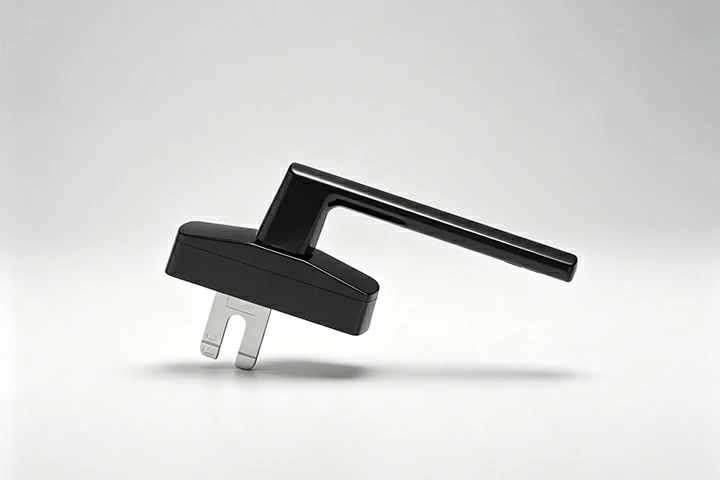
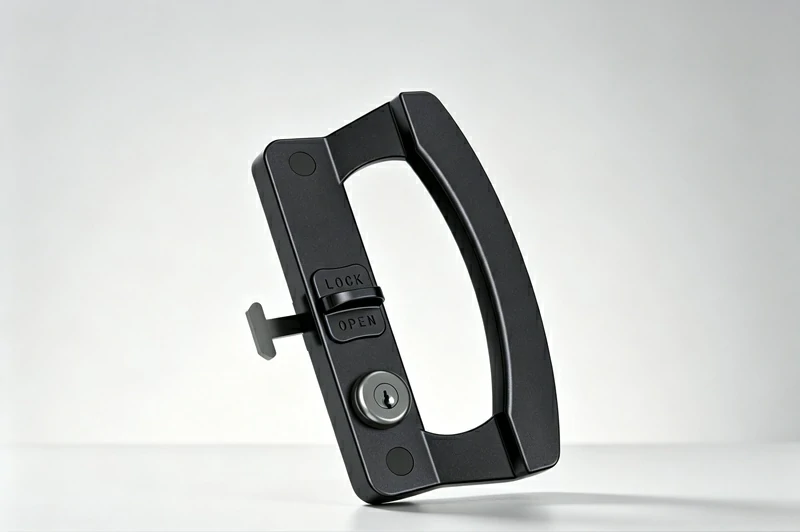
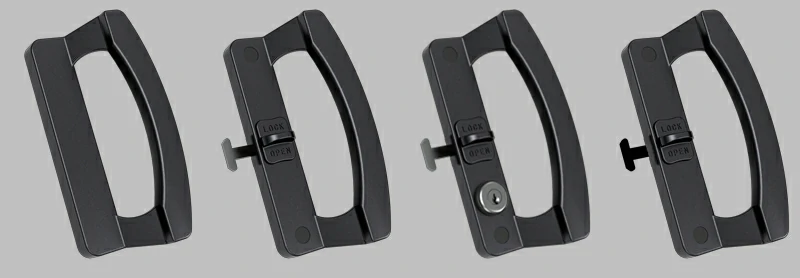
Handle and lock cylinder: the operation control part, supporting key locking function
Main lock body: the core transmission structure
Transmission rods: upper and lower linkage rods that drive lock points to move synchronously
Lock points and lock seats: matched buckling parts, distributed at different heights of the door frame
Guide accessories: limit parts and pulleys to ensure smooth transmission
When the user rotates the handle, the main lock body drives the upper and lower transmission rods to move at the same time, pushing all lock points to snap into the corresponding lock seats accurately, so as to realize multi-position synchronous locking of the entire door panel.
For commercial projects with high requirements for safety, sealing and durability, upgrading to a multipoint lock system has obvious value improvement compared with ordinary single-point locks.
1. Improved Air & Water Tightness, Reducing Building Energy Consumption
Multiple lock points are evenly distributed on the side of the door panel, which can apply uniform pressing force to the sealing strip around the door frame after locking. This eliminates the problem of loose sealing at the upper and lower ends of single-point locks, effectively blocking air leakage, rainwater infiltration and noise transmission, and significantly improving the energy-saving effect of building doors and windows. For large commercial buildings, this directly reduces the long-term air conditioning and heating operating costs.
2. Higher Anti-theft & Safety Performance
Single-point locks have only one stress point, which is easy to be pried open by external force. The multipoint locking structure disperses the stress on multiple positions. Even if one lock point is damaged, other positions still remain locked, which greatly improves the anti-prying performance. For ground-floor shops, office buildings and factory buildings with high safety requirements, this is a necessary safety upgrade.
3. Balanced Force to Extend Door Service Life
Large-size aluminum sliding doors are heavy, and single-point locking will cause long-term uneven stress on the door panel, which is easy to cause door sash deformation, pulley wear and track deviation. The multipoint lock system disperses the locking force evenly on the whole side of the door panel, maintains the stable stress state of the door sash for a long time, reduces structural wear, and effectively prolongs the overall service life of the sliding door system.
4. Uniform & Smooth Operation Experience
High-quality multipoint lock systems adopt precision-machined transmission structures. Although there are multiple lock points, they can complete synchronous locking with a single light turn of the handle, which will not increase the operation burden. LP Lipai’s multipoint lock series adopts an optimized transmission rod structure, which has low friction resistance and stable hand feeling, and can still maintain smooth operation after tens of thousands of opening and closing cycles.
The quality of multipoint locks on the market varies greatly. For commercial procurement, you can screen reliable products from the following five core dimensions.
1. Lock Point Configuration Matches Door Size
The number of lock points should be selected according to the height and weight of the door panel:
For door panels below 2.1m: 2–3 lock points can meet basic requirements
For door panels of 2.1–3m: 3–4 lock points are recommended to ensure uniform sealing
For heavy-duty sliding doors over 3m: 4–6 lock points should be configured, and reinforced transmission rods should be matched
Blindly increasing the number of lock points will increase the operation resistance, and too few lock points cannot guarantee the effect. It is necessary to select the configuration scheme matching the door type. LP Lipai provides targeted lock point configuration schemes for door panels of different specifications, and supports customized adjustment according to project requirements.
2. Material & Weather Resistance
Lock points and lock seats: Priority should be given to 304 stainless steel, which has high strength and strong corrosion resistance, and is suitable for long-term outdoor use. Zinc alloy materials can be selected for indoor projects to control costs.
Transmission rod: High-strength aluminum alloy extrusion profile is recommended, with high rigidity and no deformation under long-term stress.
Surface treatment: For coastal areas or high-humidity environments, products with thickened anodizing or fluorocarbon coating should be selected to resist salt spray corrosion.
3. Transmission Precision & Fit Clearance
The fit accuracy between the transmission rod, lock point and lock seat directly determines the service life and hand feeling. Products with poor precision are prone to jamming, misalignment and abnormal noise after a period of use. High-quality multipoint locks have small fit clearance, synchronous movement of each lock point, and no jamming or idle stroke during operation.
4. Certification & Durability Test
Formal commercial projects require products to comply with relevant quality standards. Priority should be given to products that have passed ISO9001 system certification and CE certification, and have passed standard durability tests:
Opening and closing cycle test: high-quality products can reach more than 30,000 cycles without failure
Salt spray corrosion test: no obvious corrosion after 200–500 hours of testing
Tensile and anti-prying test: meet the corresponding anti-theft level standards
All multipoint lock products of LP Lipai are tested for performance indicators in our CNAS-accredited laboratory, and the test data are true and traceable, which can meet the acceptance standards of most commercial projects.
5. Compatibility with Profile Systems
Different door profile brands have different groove designs. Before purchase, confirm whether the lock system matches the profile groove type to avoid installation mismatch. Professional suppliers can provide matching schemes according to the profile model used by the customer, and even carry out adaptive improvement for special profiles.
Correct installation is the premise to ensure the performance of the multipoint door lock system. The standard installation process is as follows:
Pre-installation preparation: Confirm that the door profile slot matches the lock specification, and prepare tools such as electric drills, screwdrivers and measuring rulers.
Profile slotting: Open the corresponding installation holes and transmission rod grooves at the designated positions of the door panel according to the product installation drawing.
Install the main lock body and handle: Fix the main lock body at the handle position, and install the handle and lock cylinder.
Arrange transmission rods and lock points: Install upper and lower transmission rods, fix lock points at corresponding positions, and test the linkage effect.
Install lock seats on the door frame: Adjust the positions of lock seats to ensure that all lock points can be accurately snapped in when locked.
Debugging and inspection: Repeatedly test opening, closing and locking, fine-tune the position of lock points to ensure smooth operation, tight locking and no uneven stress.
Common Faults & Solutions:
Lock points are misaligned and cannot be locked: Adjust the up and down positions of the lock seat to ensure alignment with the lock point.
Stiff operation and large rotating resistance: Clean dust from the transmission rod, and apply a small amount of special lubricant to the moving parts.
Individual lock points do not snap into place: Check whether the transmission rod is loose or displaced, and readjust the fixing position.
Clean dust and sundries on the surface of the lock and transmission rod regularly every 3–6 months.
Add lubricant to the lock cylinder and transmission parts to keep the operation smooth.
Do not slam the door violently or apply external force to the handle, so as to avoid deformation of the transmission structure.
For commercial aluminum sliding door projects, a high-quality multipoint door lock system is not an optional accessory, but a key component related to building safety, energy efficiency and long-term use cost. Choosing products with reasonable configuration, reliable materials and strict quality control can avoid a lot of later maintenance and replacement costs.
If you are looking for stable and durable aluminum sliding door multipoint lock products for your project, or need customized lock solutions for special door types, LP Lipai can provide you with full technical support and product supply services. Our multipoint lock series covers a variety of specifications from conventional household models to heavy-duty commercial models, supports OEM customization, and all products have passed strict laboratory quality testing. Welcome to contact us to get the full product catalog and project quotation.